
How to Identify Plain Weave Fabric
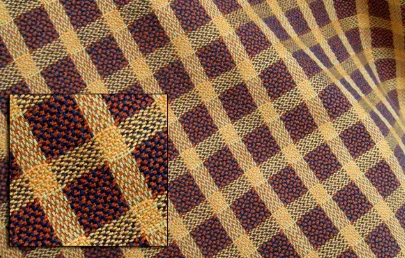
Plain weave is the most common type of weave and forms the base for all other weaves and fabrics. It is used in many of the garments on the high street as well as in many of the industrial fabrics that are used for specialized applications. It has a simple yet strong structure. To correctly identify plain weave, it is necessary to look at the way it looks, feels and performs. This article describes how to correctly identify plain weave using visual identification, physical identification and structural identification.
What Defines a Plain Weave?
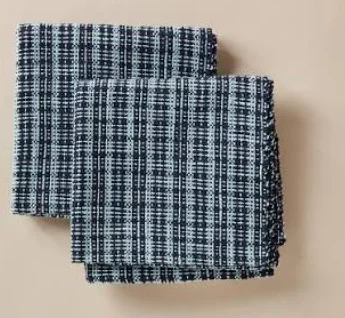
This balanced weave creates a plain surface of interlacing warp and weft threads that forms a check or tessera pattern on the surface of the fabric. It is important to note the differences between plain weave, twill and satin weaves prior to attempting to identify a fabric that is plain weave.
Interlacing Pattern of Warp and Weft
In plain weave every weft yarn is woven over and under the warp yarns in a systematic and repeating sequence. As a result of this type of weave the amount of stretch in a weave of this type is kept to a minimum and a tight and stable grid is produced. This tight grid enables the various threads to cross each other at right angles in order to give maximum strength and dimensional stability to the material.
Visual Appearance of the Fabric Surface
The plain weave is visible to the naked eye in the simple alternating diagonal cross and looks exactly the same from both sides of the fabric. Unlike the twill fabrics, which have distinct diagonal ribs, and satin weaves, which have shiny surfaces, the plain weave are not recognizable as such, but there are many examples of such fabrics, like muslin, poplin, taffeta, canvas etc.
Structural Balance Between Warp and Weft
The equal distribution of warp and weft tension gives plain weave its firm hand feel. The density ratio between these two directions often remains close to 1:1, resulting in consistent strength across the fabric width and length.
How Can One Visually Identify Plain Weave Fabric?
First we visually identify the textile as a woven one and then within the woven category look for the indicators that will verify that it is a plain weave. We will then learn how to recognize it from other structures as well.
Before you can examine the surface of an object under magnification, look at how it reflects light. Check to see if both sides of the object appear to have the same texture and color.
Uniform Checkerboard Texture
The plain weave construction has a distinctive grid-like appearance created by the over and under crossing of two yarns traveling in opposite directions, typically perpendicular to each other. The fabric’s intersection points form little square or rectangular areas and provide a uniformly spaced surface as opposed to the diagonal ridges found in twill and the shiny surface of satin.
Absence of Diagonal Lines or Glossy Sheen
Unlike twill or satin fabrics that have strong diagonal characteristics or are shiny in one direction and dull in the other, plain weave has a matte finish without any distinctive diagonal lines. The surface has a flat appearance and this is because of the way that light scatters off the weave. Because of the high frequency of interlacings, light scatters evenly off of plain weave.
Consistent Yarn Density Across the Surface
As warp and weft are interlaced equally often for this textile, thread density appears to be constant across the material. Observing the fabric against light suggests that it is all of roughly even density, with no areas looking to be more densely woven than others and none less so.
What Tactile Features Distinguish Plain Weave Fabrics?
In addition to evaluating the appearance of the weaves by means of a visual inspection, tactile evaluation indicates how closely the individual threads are woven together and how they feel when being held in the hand.
Touching and feeling can help to confirm whether a given specimen belongs to plain weave by identifying certain degrees of firmness and of air-permeability that distinguish plain weave from others.
Firmness and Stability to Touch
The plain weave has frequent intersections between the yarns that restrict their movement greatly, giving the fabric a firm handle. They have good resistance to distortion when pulled at an angle, and are used in making up into shapes requiring great retention of shape such as shirts and also for the bases of upholstered articles.
Breathability Due to Open Interstices
In order to create fabrics that are firm and lightweight at the same time, there are some plain weaves such as voile or organza, which – although tight – allow for air to pass through the small spaces between the yarns. Therefore these fabrics are very comfortable to wear in warm weather.
Smooth Yet Slightly Grainy Hand Feel
The many crossings produce fine micro-relief which is perceivable by the fingertips. The fabric surface is smooth but not slippery. It is very different from satin which is smooth and slippery and twill which has relief in wavy lines.
How Does Thread Count Affect Identification Accuracy?
Thread count greatly affects the ability to recognize a plain weave, either by eye or by touch. Higher thread count fabrics are often so dense that individual yarns may not be visible, while lower thread count fabrics will reveal the individual yarns clearly.
To determine the technical count of a fabric we count the threads per inch in the warp and weft direction using a pick glass or magnifier.
Low Thread Count Fabrics Show Clear Interlacings
Coarse cotton fabrics like cheesecloth or gauze have every crossing point clearly visible since in such fabrics there are fewer threads per square inch than in other types of cotton fabrics. The most elementary principles of weaving are illustrated by these teaching fabrics.
Medium Thread Count Offers Balanced Performance
Poplin or chambray are two examples of medium-density plain weaves with a medium degree of softness, durable enough for wearing often while the interlacings remain visible on the surface of the fabric. In general, the interlacings are pressed together enough to wear without seeing through the fabric.
High Thread Count Creates Compact Surfaces
Some of the fine shirtings made up of very closely spun yarns can be so intricately woven that it is not possible to see the weave when looking at the fabric without the aid of magnification. However, because the fabric is so balanced and has an even and consistent reflection, it can be identified as a plain weave even though the intersections are not visible.
Why Is Yarn Type Important in Identifying Plain Weave?
The plain view of a yarn’s structure is influenced by the yarn composition. The properties of the fibers within a yarn affect the yarn’s reflectivity, thickness uniformity and stiffness.
Care should be exercised by all professionals not to misinterpret construction variation as structural deviation when in fact it could arise from inherent fiber variation.
Natural Fibers Like Cotton or Linen Highlight Texture Clearly
The dull surface of the cotton allows the crossing points of the weave to be more visible than on the shiny surface of the linen. The irregular slubs of the linen, on the other hand, help to highlight the grid in the weave, making the two-dimensional checkerboard pattern of the plain weave more recognizable.
Synthetic Yarns May Obscure Weave Clarity
Some of the polyester versions have appeared to be smoother because of filament continuity that has reduced the textural contrast between the warp and weft intersections. Magnified viewing is essential to confirm this though.
Blended Yarns Alter Surface Reflection Patterns
Cotton polyester blends are difficult to identify due to the mix of natural and synthetic fibers that can give them a slight sheen that obscures interlacings; they are best identified using microscopic examination to understand the structure of the fibers and their resulting characteristics versus the fiber’s gloss.
What Are Common Testing Methods Used by Professionals?
Apart from visual inspection textile laboratories use standardized testing to verify the precise fabric construction. These test methods are crucial as commercial labeling states weave type and factual verification is necessary.
The tests are a combination of mechanical observation and digital imaging allowing for precise and reliable classification of products from different production batches.
Microscopic Examination Under Magnification
The use of 10×–40× magnifiers enables clear observation of alternating over-under crossings thereby confirming a true plain weave construction without any directional bias that would be present in twills and satins.
Pick Glass Counting Technique
A pick glass helps measure ends per inch (EPI) along warp direction and picks per inch (PPI) along weft direction; equal counts usually indicate balanced plain weave structures suitable for quality control documentation.
Digital Weave Analysis Software
With the latest advanced imaging software, high-resolution images of fabric samples are captured and translated into high-resolution binary images that display the intersection frequency. Automated sorting and classification algorithms then sort samples into three fabric types: plain, twill and satin. This the algorithms use to calculate the pixel distribution ratios.
FAQ
Q1. What is the Simplest Way to Recognize Plain Weave Fabric? A. An even crisscross pattern. Follow one warp end across the weave, it will go over one weft end then under the next. It will continue in this manner across the weave in both directions. Both sides of the fabric will appear identical. There will be no diagonal ribs or differences in sheen.
Q2. Can Plain Weave be used for Heavy Duty Applications. A. Yes. Heavy canvas or duck cloth is made up of coarse yarns set in a plain configuration to provide the most durable of fabrics, ideal for making out doors products such as; tents, bags and work wear bases.
Q3. Does Thread Count Always Indicate Quality? A. No – higher thread counts can produce smooth quality fabrics but are less breathable; whilst lower counts increase airflow, can be less strong – quality depends on use.
Q4. Are All Poplins Considered Plain Weaves? A. Yes. From fine warp faced plain weaves originally made up of finer yarns of warp and weft, a higher warp density provides a very subtle rib as against normal plain weave fabrics having more or less equal count of warp and weft yarns. In fine count poplin construction however, the basic over-under sequence of end & pick in plain weave is maintained as against twill where the sequence is diagonal.
Q5. Why do some plain weaves appear shinier than others? A. What appears to give more shine to some plain weaves as opposed to others is the fiber used. Natural staples will not give as much shine as synthetic filaments. The weave pattern itself remains unchanged and therefore does not constitute variations of plain weaves.