Weaving twill on a rigid heddle loom without overcomplicating the setup
What makes twill different on a rigid heddle loom
Weaving twill on a rigid heddle loom is possible, but it asks more of the loom than plain weave does. A single rigid heddle naturally gives two basic sheds: heddle up and heddle down. Twill depends on a repeating offset in the interlacement, which creates the diagonal ribs associated with denim, gabardine, many tartans, and other familiar fabrics. To make those diagonals, the weaver must control more than two warp groups. On a rigid heddle loom, that added control usually comes from a pick-up stick, string heddles, a second rigid heddle, or a combination of these tools.
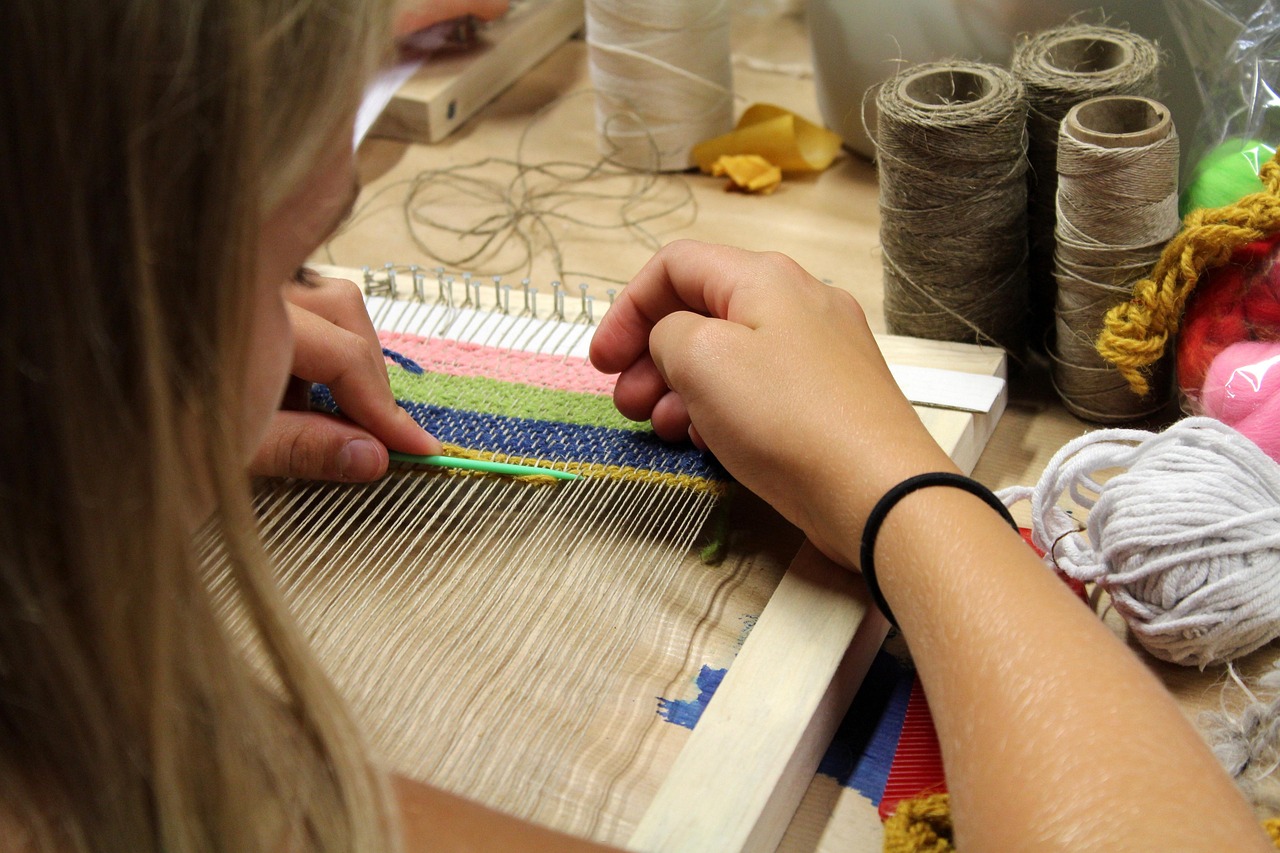
The important point is not to treat the rigid heddle loom as a floor loom. It has a different rhythm, a shorter shed, and more hand manipulation. Once those limits are understood, twill becomes a practical structure for sampling and small projects rather than a technique reserved only for multi-shaft looms. You can also explore more in Weaves.
How twill structure creates diagonal cloth
Twill is not defined by color, yarn type, or fabric weight. It is a weave structure. In a basic twill, each weft pick passes over and under groups of warp ends, then the next pick shifts that order by one or more ends. This step, or offset, forms a visible diagonal line across the cloth.
A 2/2 twill, for example, means the weft typically passes over two warp ends and under two warp ends in a repeating order. A 1/3 twill and a 3/1 twill use a different balance of floats, so one face may show more warp or more weft. In practical terms, twill often feels more flexible than plain weave at the same sett because the yarns float over more than one thread before interlacing again.
That flexibility is one reason twill matters in textile design. It can drape well, show strong diagonal movement, and display color-and-weave effects clearly. Floats also add risk. If the yarn is too slippery, the sett is too open, or the floats are too long for the intended use, the fabric can snag or lose stability.
For readers comparing structures across weaving methods, Huashi Digital’s weaves section provides broader context on how interlacement choices influence fabric appearance and performance.
Why one rigid heddle is usually not enough
A standard rigid heddle combines two jobs: it spaces the warp like a reed and moves selected warp ends like a heddle. Warp ends in the holes move with the heddle; warp ends in the slots remain comparatively neutral as the heddle moves up or down. That arrangement works efficiently for plain weave because two sheds are enough. One shed lifts one set of ends, and the opposite shed reverses the order.
Twill requires a sequence of several different sheds. A classic straight twill needs a planned rotation of warp groups so the interlacement steps across the fabric. With only the normal up and down positions, the loom cannot create that sequence by itself. The missing control has to be added manually.
This is where many beginners become frustrated. The issue is not necessarily beating, shuttle handling, or yarn choice. It is mechanical: a single rigid heddle has limited built-in shaft control. For most twill drafts on this loom, pick-up sticks and string heddles are not optional accessories; they are the tools that make extra sheds possible.
Three practical ways to weave twill on a rigid heddle loom
There is more than one route to twill. The best method depends on the loom, the project width, the yarn, and how much setup time the weaver is prepared to manage. The comparison below is a useful starting point before choosing a draft.
| Method | What it adds | Useful for | Main limitation |
|---|---|---|---|
| Pick-up stick | Temporary control of selected slot threads | Narrow samples, simple floats, learning how sheds change | Can become slow when the sequence is long |
| Pick-up stick plus string heddles | A repeatable extra warp group | Basic three-shaft-style twills and more consistent sampling | Requires careful setup and clear labeling |
| Two rigid heddles with auxiliary controls | More organized warp grouping and finer sett options | More complex twill experiments, denser cloth, wider projects | Needs compatible heddles, extra loom depth, and patient shed management |
The simplest entry point is often a narrow sampler using one pick-up stick. It lets the weaver see how lifted and lowered groups form floats. A sampler, however, is not the same as a production method. If every pick requires reselecting threads, the process will be too slow for a scarf, towel, or longer fabric length.
String heddles solve part of that problem by holding a selected group of warp ends on a rod. Instead of picking the same ends repeatedly, the weaver can lift or park that group as part of the shed sequence. This makes the rhythm more manageable and improves consistency across the fabric.
Two-heddle setups can organize the warp into more controllable groups, but they are not automatically easier. Two heddles bring their own complications: threading must be accurate, the heddles need room to move, and the shed can become crowded. For many weavers, two heddles plus one auxiliary control offer a better compromise than trying to force a wide or dense twill through a very simple setup.
Planning yarn, sett, and width before warping
Twill planning starts before the warp reaches the loom. Because twill floats over multiple ends, yarn size and sett are critical. A sett that works for plain weave may be too open for twill if the floats look loose or unstable. On the other hand, a sett that is too dense can make sheds difficult to clear on a rigid heddle loom, especially when two heddles or string heddles are added.
For a first attempt, a smooth, medium-weight yarn is easier than a fuzzy, highly elastic, or heavily textured yarn. Strong contrast between warp and weft can help reveal the twill line in a sampler, but extreme contrast also makes threading errors more obvious. Cotton, wool, and blended yarns can all work, provided the yarn passes cleanly through the heddle holes and slots without abrasion.
Project width should also be conservative. Twill on a rigid heddle loom involves more shed manipulation than plain weave, so a narrow sample gives clearer feedback. A 6 to 10 inch sample can teach more than an ambitious full-width warp that becomes tiring after the first few repeats. Once the sequence is reliable, the same idea can be scaled up with more confidence.
Leave generous loom waste when sampling. Extra heddles, rods, and pick-up sticks take space, and the effective weaving area may be shorter than expected. It is better to plan a shorter finished cloth than to run out of working room before the structure is understood.
A careful workflow for a first twill sampler
A first twill sampler should be treated as a learning fabric, not a finished product. The goal is to confirm that the threading, shed order, and beat can produce a stable diagonal line. See also: Applications.
- Choose one draft family. Start with a simple straight twill or broken twill concept rather than changing structures mid-warp.
- Map warp groups before threading. Decide which ends are controlled by the rigid heddle, which are selected by the pick-up stick, and which are assigned to string heddles if used.
- Use a short, visible repeat. A repeat that is easy to count reduces mistakes and makes the diagonal easier to check.
- Weave a plain-weave header. This spreads the warp, stabilizes the edge, and gives a clear starting line.
- Record the shed sequence. Keep the order written beside the loom. Do not rely on memory during the first sample.
- Check the diagonal every few repeats. If the line breaks, stop and identify whether the error is threading, shed order, or a missed pick.
- Finish and wash the sample. Twill can change noticeably after wet finishing, so judge the final hand and stability only after washing or steaming in a way appropriate to the yarn.
It also helps to mark each control device. Labels such as “front heddle,” “back heddle,” “pick-up A,” or “heddle rod B” prevent confusion when the sequence becomes repetitive. This is especially useful when the same physical action appears in different parts of the draft.
Common problems and how to correct them
The diagonal line disappears
If the fabric starts as twill and then turns visually flat or irregular, the likely cause is a skipped or repeated shed. Twill depends on the order of the sequence, and one wrong pick can interrupt the diagonal. Unweave to the last correct repeat rather than trying to hide the error; twill mistakes often remain visible after finishing.
The shed is too small
A crowded shed is common when using two heddles or string heddles. Check that the warp is not over-tensioned, because excessive tension can reduce shed height. Also confirm that auxiliary rods are placed where they can move cleanly. If the shuttle scrapes through every pick, the sett may be too dense for that yarn and loom combination.
The cloth draws in at the edges
Twill floats can make draw-in more noticeable because the weft does not interlace as frequently as it does in plain weave. Use a consistent weft angle, avoid pulling the shuttle tight at the selvage, and consider a temple only if the loom and project allow safe use. For narrow samplers, careful weft placement is usually enough.
The fabric feels unstable
Loose floats, an open sett, or a slippery yarn can make the cloth unstable. The correction may be a closer sett, a shorter float structure, a different yarn, or firmer wet finishing. If the fabric will become a towel, bag, or upholstery-like textile, stability matters more than achieving the longest possible float.
When twill is worth doing on a rigid heddle loom
Twill on a rigid heddle loom is worth doing when the project benefits from visible diagonal texture, softer drape, or a better understanding of weave structure. It is especially useful for sampling because the weaver can explore structure without owning a floor loom or table loom.
It may not be the best choice when speed, width, and repeatability are the main goals. A long run of 2/2 twill yardage is usually more efficient on a multi-shaft loom. A rigid heddle loom can achieve related effects, but it often does so through manual steps that slow production. That is not a weakness; it is the trade-off of working on a compact loom.
For educators, designers, and small-studio weavers, that trade-off can be useful. The rigid heddle loom makes the logic of twill visible. The weaver can see which warp group is being lifted, how the offset forms, and why one error changes the diagonal. That structural awareness carries over to other loom types and more advanced textile planning.
Frequently asked questions
Can you weave 2/2 twill on a rigid heddle loom?
Yes, but not with the ordinary up-and-down action of a single rigid heddle alone. A 2/2 twill needs several controlled warp groups, so it generally requires added tools such as a second heddle, pick-up stick, heddle rod, or string heddles. It is better approached as an intermediate technique.
Is 1/3 twill easier than 2/2 twill on a rigid heddle loom?
It can be easier in some setups because certain three-shaft-style sequences are more manageable with auxiliary controls. However, “easier” depends on the threading, the loom, and the weaver’s comfort with pick-up work. Sampling is the safest way to compare them.
Do I need two heddles for every twill pattern?
No. Some twill-like effects and narrow samples can be made with pick-up sticks and string heddles. Two heddles can make certain structures more organized, but they also add complexity. The draft should determine the tools, not the other way around.
What yarn is best for a first rigid heddle twill sample?
A smooth, firm yarn in a medium size is usually easiest. Avoid very fuzzy yarns for the first sample because they can cling in the shed and obscure the structure. A moderate color contrast between warp and weft helps reveal the diagonal.
Should a beginner try twill before mastering plain weave?
It is better to be comfortable with warping, tension, selvages, and plain-weave rhythm first. Twill adds shed sequencing and extra controls, so basic loom handling should already feel familiar. Once those skills are stable, a small twill sampler is a logical next step.
The practical takeaway
Weaving twill on a rigid heddle loom is less about forcing the loom to behave like a four-shaft loom and more about adding the right amount of control for the cloth you want. A single heddle is excellent for plain weave, but twill needs extra shed options. Pick-up sticks, string heddles, and second heddles provide those options in different ways.
The most reliable path is to begin small, use a clear shed sequence, record every control movement, and judge the fabric after finishing. With that approach, twill becomes a practical structure for exploration, sampling, scarves, small towels, and design development on a loom many weavers already own.