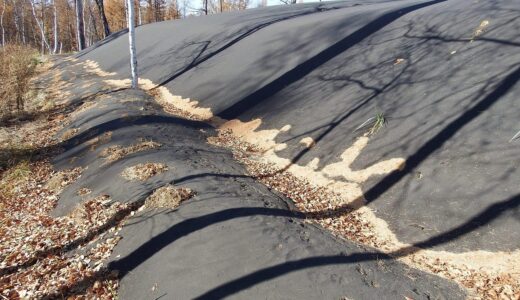
Polypropylene black woven stabilization underlayment for roads, slopes and hardscapes
Polypropylene black woven stabilization underlayment is a permeable woven geotextile installed between prepared soil and aggregate, fill, stone or hardscape base layers. Its job is not simply to “cover the ground.” It separates weak subgrade soil from granular material and adds tensile resistance during placement and service. That makes it useful for driveways, temporary roads, building pads, trails, paver bases, slope work and other areas where rutting, pumping or aggregate loss may occur.
It is not a universal substitute for drainage fabric, geogrid, proper compaction or pavement design. The right material depends on soil condition, aggregate type, construction loading, hydraulic requirements and the project specification.
What the term means
The phrase “polypropylene black woven stabilization underlayment” combines several technical ideas that are often blended together in retail listings, site specifications and construction discussions.
- Polypropylene is the polymer used to make the yarns or tapes. It is common in geotextiles because it is lightweight, resistant to many soil environments and does not absorb water in the way natural fibers do.
- Black usually refers to the fabric color. In many polypropylene geotextiles, black pigmentation is associated with UV stabilization packages, but color alone should not be treated as proof of long-term sunlight resistance.
- Woven means the fabric is made by interlacing yarns, slit-film tapes, monofilaments or multifilaments. This structure usually provides higher tensile strength and lower elongation than many nonwoven fabrics.
- Stabilization underlayment describes the application. The fabric is placed below a structural or semi-structural layer, most often aggregate, to help the section remain stable.
In engineering language, this material is normally described as a woven polypropylene geotextile for separation and stabilization. In landscape and hardscape markets, similar products may be called driveway fabric, road fabric, ground stabilization fabric, underlayment or heavy-duty landscape fabric. Those names can describe the same general category, but they do not replace a project-specific material specification.
Why woven stabilization underlayment is used
The basic problem is layer contamination. When crushed stone is placed directly over soft, wet or fine-grained soil, repeated loading can push aggregate down into the subgrade while fine soil pumps upward into the stone layer. The base then loses thickness, drainage capacity and load-spreading ability. The surface may rut, settle or require more maintenance.
A woven stabilization underlayment helps by creating a continuous separation layer. It keeps the aggregate skeleton cleaner and helps distribute construction loads over a wider area. Federal Highway Administration guidance on geosynthetics describes stabilization as a combination of separation, filtration and reinforcement functions. In the field, the underlayment is doing several jobs at once: limiting soil migration, maintaining base layer integrity and contributing tensile resistance when aggregate tries to move laterally.
The benefit is usually most visible where the subgrade is weak, seasonally wet or fine-grained. It is also useful where equipment needs a working platform before final paving, landscaping or surfacing. However, the fabric cannot correct poor construction by itself. If the soil is not prepared, the aggregate is too thin, drainage is inadequate or the fabric is damaged during installation, performance will still be limited.
Where it fits in real applications
Polypropylene black woven stabilization underlayment is most appropriate where separation and moderate stabilization are the primary functions. The table below summarizes common use cases and the main design question for each one.
| Application | Typical fabric role | Key question before selection |
|---|---|---|
| Gravel driveways and access roads | Separates subgrade from aggregate and helps reduce rutting | Is the aggregate thickness sufficient for the expected vehicle loads? |
| Construction entrances and temporary roads | Creates a working platform over weak or disturbed soil | Will the fabric survive construction traffic and angular stone placement? |
| Paver patios and walkways | Helps prevent subgrade fines from migrating into the base layer | Is filtration or drainage more important than tensile strength? |
| Building pads and equipment pads | Maintains a cleaner interface below compacted granular fill | Has a qualified designer confirmed the required fill depth and compaction? |
| Slopes and embankment faces | Assists separation below cover soil, stone or erosion-control layers | Is the slope design relying on reinforcement, erosion control, drainage or all three? |
These applications are related, but they are not identical. A driveway underlayment may be selected for survivability under aggregate, while a drainage trench fabric may require stronger filtration performance. A slope may need erosion-control matting or engineered reinforcement in addition to a woven geotextile. The useful question is not “Is the fabric heavy duty?” but “What function must the fabric perform in this layer?”
Specifications that matter more than color or roll size
For casual projects, buyers often compare width, length, color, thickness and price. For civil, commercial or long-life hardscape work, those details are not enough. A proper specification should define measurable properties and the test methods used to verify them.
Survivability during installation
The fabric must survive stone placement, equipment movement, turning, compaction and possible abrasion from angular aggregate. Relevant properties may include grab tensile strength, seam strength, trapezoid tear resistance and puncture resistance. AASHTO M 288 and many state transportation specifications use survivability concepts because a geotextile that tears during installation cannot perform its design function.
Hydraulic compatibility
Even a woven stabilization fabric should not trap water in a way that weakens the section. Apparent opening size, commonly abbreviated AOS, helps indicate how the fabric retains soil particles. Permittivity and water flow rate describe how water moves through the geotextile. ASTM D4751 is commonly associated with AOS testing, while ASTM D4491 is commonly used for water permeability by permittivity. These values should be considered together with the site soil, not reviewed in isolation.
UV resistance and exposure limits
Polypropylene can degrade under prolonged ultraviolet exposure. Black pigmentation and stabilizers can improve resistance, but the decisive information is the manufacturer’s stated exposure limit and UV test data, often associated with ASTM D4355 or ASTM D4355M. For underlayment applications, the safest practice is to cover the fabric promptly after placement rather than leave it exposed for extended periods.
Minimum average roll values
In professional geotextile specifications, material values are often presented as minimum average roll values, or MARV. This matters because one sample result does not describe an entire production roll. When the project is more than a small landscape installation, request a data sheet, certification and the relevant test methods rather than relying only on product names.
Woven, nonwoven and geogrid are not interchangeable
One common mistake is treating every black geosynthetic sheet as the same material. Woven geotextile, nonwoven geotextile and geogrid can all appear in stabilization work, but they are selected for different functions.
Woven polypropylene geotextile is often chosen for separation and stabilization because the woven structure provides tensile strength and dimensional stability. It is a strong candidate below gravel driveways, unpaved roads, working platforms and aggregate bases where soil separation is important.
Nonwoven geotextile is typically made from fibers bonded by needle punching or heat. It is often preferred where filtration, drainage, cushioning or protection is the main function. Around drainage pipes, behind retaining walls or in some erosion-control assemblies, a nonwoven filter fabric may be more appropriate than a woven slit-film fabric.
Geogrid is an open-grid reinforcement product designed to interlock with aggregate and provide lateral confinement. It can improve load distribution in a base layer, but it does not stop fine soil from pumping upward in the same way a continuous geotextile separator does. In some designs, a geogrid and geotextile are used together or supplied as a composite.
The selection should follow the likely failure mode. If the issue is aggregate contamination, choose a separator. If the issue is drainage filtration, choose a filter. If the issue is aggregate confinement under repeated loading, evaluate reinforcement. Many projects need more than one function. See also: Coatings.
Installation details that affect performance
Good underlayment can fail if it is installed poorly. The preparation and cover sequence are often as important as the fabric itself.
- Prepare the subgrade. Remove brush, debris, roots and sharp objects. Fill voids and shape the surface to the planned grade. The fabric should rest on a reasonably smooth layer, not bridge holes or wrap around protrusions.
- Place the fabric flat and tight. Wrinkles, folds and trapped pockets reduce contact and can create weak points during aggregate placement.
- Overlap adjacent rolls. Some product instructions use a minimum overlap such as 12 inches, but soft soils, heavy loads or poor subgrade conditions may require larger overlaps or sewn seams depending on the specification.
- Secure edges and overlaps. Staples, pins or temporary weights help prevent shifting before aggregate is placed. On slopes, anchoring should be reviewed carefully because gravity and runoff can move unsecured fabric.
- Cover without damaging the fabric. Dumping large, sharp stone directly from height can puncture or displace the geotextile. Controlled placement and adequate initial lift thickness reduce the risk of damage.
- Avoid direct traffic on exposed fabric. Equipment should generally operate on the aggregate layer, not on the uncovered geotextile, unless the project specification allows it.
For small hardscape projects, these steps may look simple. For roads, pads and slopes, the same principles become quality-control points. The fabric must remain continuous, clean and undamaged until the aggregate or cover layer is in place.
Common specification mistakes to avoid
The first mistake is using thickness as the main quality indicator. Thickness can be useful, but it does not prove tensile strength, puncture resistance, hydraulic behavior or UV durability. A thin engineered woven may outperform a thicker product in one application and underperform in another.
The second mistake is confusing weed barrier with stabilization underlayment. Some woven polypropylene fabrics are sold in landscape categories, but a weed-control fabric for planting beds is not automatically suitable below a loaded aggregate base. Stabilization work needs survivability and separation data.
The third mistake is assuming the fabric reduces the required base thickness. Engineering references often caution that a separator or stabilizer should not be treated as a simple replacement for pavement design unless the design method specifically accounts for it. Aggregate depth, compaction, drainage and loading still matter.
The fourth mistake is leaving polypropylene exposed too long. UV resistance helps during installation, but most underlayment applications are designed to be buried. Cover the material promptly and store rolls protected from sunlight, moisture contamination and site damage.
The fifth mistake is choosing woven fabric for every water-related detail. Where water flow and soil filtration control the performance, a nonwoven or engineered filter geotextile may be the better material. A woven stabilizer is strong, but strength is not the only requirement.
How to specify it more clearly
A clear project note should identify the function, material, test requirements and installation expectations. Instead of writing only “black fabric” or “heavy-duty underlayment,” a better specification may state that the work requires a woven polypropylene geotextile for separation and stabilization below aggregate, with certified mechanical and hydraulic properties suitable for the subgrade and construction conditions.
For professional projects, the specification should also reference the applicable local transportation or public works requirements, the relevant AASHTO or ASTM standards, minimum overlap or seam requirements, storage conditions, exposure limits and submittal documents. For small private projects, the same logic can be simplified into a checklist: confirm the fabric type, intended application, strength data, water flow data, roll dimensions, overlap guidance and cover requirements.
For more textile application topics, visit the Applications section.
Frequently asked questions
Is polypropylene black woven stabilization underlayment waterproof?
No. It is generally a permeable geotextile, not a waterproof membrane. Its purpose is to separate and stabilize layers while still allowing water movement. If waterproofing is required, the design would normally involve a geomembrane or another barrier system, not standard woven stabilization fabric.
Can it be used under a gravel driveway?
Yes, this is one of the common uses, provided the subgrade is prepared and the aggregate layer is thick enough for the expected traffic. The fabric helps keep soil and stone from mixing, but it does not replace proper base depth, compaction or drainage.
Is woven fabric better than nonwoven fabric?
Neither is universally better. Woven fabric is often stronger in tension and useful for separation and stabilization under aggregate. Nonwoven fabric is often preferred for filtration, drainage and cushioning. The correct choice depends on the function required at that layer.
How much overlap is needed between rolls?
Some manufacturer instructions give minimum overlaps such as 12 inches, but site conditions may require more. Weak soils, heavy construction traffic, slopes and saturated subgrades can justify larger overlaps or seams. Follow the project specification when one is provided.
Does black color mean the fabric can stay exposed?
No. Black color may indicate pigmentation and possible UV stabilization, but exposure resistance should be confirmed from the manufacturer’s data. Most polypropylene underlayment should be covered soon after installation to preserve performance.