Geotech fabric for separation, filtration and drainage applications

What geotech fabric does in civil engineering
Geotech fabric is a permeable textile material used with soil, rock, aggregate or other geotechnical materials to support separation, filtration, drainage, reinforcement and protection. In the field, it is usually placed between soil layers, below aggregate or around drainage structures so water can move while soil particles, aggregate layers or engineered fill stay where the design requires them. This makes geotech fabric important in road bases, retaining walls, subsurface drains, erosion control works, rail ballast, landfill systems and other ground-related applications.
Geotech fabric should not be selected by weight or thickness alone. The required performance depends on the site condition and the primary design function. Fabric placed under riprap must resist installation damage and retain soil. Fabric behind a wall must pass water without clogging. Fabric below aggregate on weak subgrade must help prevent the base layer from mixing with fine soil. More textile and construction topics are covered in the Applications section.

Geotech fabric, geotextile and geosynthetic are related but not identical
The term geotech fabric is widely used in procurement, construction and general industry writing. In standards and engineering documents, the more precise term is usually geotextile. ASTM D4439 describes a geotextile as a permeable geosynthetic made only of textiles. ISO terminology also treats a geotextile as a planar, permeable textile material used in contact with soil and other materials in civil engineering and geotechnical applications.
Geosynthetic is the broader category. It can include geotextiles, geogrids, geomembranes, geonets, geocells, geocomposites and geosynthetic clay liners. A geotextile is therefore one type of geosynthetic, while geotech fabric is generally a market term for geotextile fabric used in ground engineering. The distinction matters because different geosynthetic products solve different design problems. A geomembrane is mainly used as a fluid barrier, while a geogrid is often used for reinforcement and stabilization. A geotextile may separate soil layers, filter water, provide limited reinforcement, protect liners or assist drainage, depending on its construction and properties.
Main functions of geotech fabric
Engineering guidance from organizations such as the International Geosynthetics Society, AASHTO, FHWA and state transportation agencies generally describes geotextile performance by function. One roll of fabric may provide more than one function, but one primary function usually controls the specification.
Separation
Separation means keeping two dissimilar materials from mixing. In a road section, geotech fabric can be placed between a fine-grained subgrade and a granular base. Without a separator, traffic loads, construction equipment and water movement can cause fines to pump upward into the aggregate layer, while aggregate can press down into weaker soil. The result can be loss of base thickness, reduced drainage capacity and rutting.
For separation applications, the fabric must survive aggregate placement and construction traffic. It must also have openings small enough to reduce soil migration while still allowing water movement. Woven geotextiles are often associated with separation because they can provide high tensile strength and lower elongation. Some nonwoven fabrics are selected when drainage or cushioning is also needed.
Filtration
Filtration allows water to pass while retaining soil particles. This function is critical around drainage aggregate, pipes, edge drains, riprap and erosion protection systems. A filter fabric that is too open may allow soil loss and internal erosion. A fabric that is too tight may clog or restrict flow, which can create water pressure behind walls, beneath pavements or under slope protection.
Important filtration properties include apparent opening size, permittivity and permeability. Apparent opening size relates to the particle size the fabric can retain. Permittivity describes cross-plane water flow through the fabric. Permeability compares how readily water moves through the fabric relative to the soil. Engineering manuals often evaluate these properties together rather than treating any single value as sufficient.
Drainage
Drainage can mean water passing through the fabric or moving along the plane of the fabric. Nonwoven needle-punched geotextiles are often used in drainage because their fiber structure can provide void space for water movement. In some applications, the geotextile is combined with a drainage core to form a geocomposite. The fabric acts as the filter, while the core carries the flow.
Typical drainage uses include pavement edge drains, retaining wall backdrains, landfill cap drainage, trench drains and systems designed to dissipate pore water pressure. The fabric must be compatible with the surrounding soil. Drainage failure is often caused not by a lack of laboratory flow capacity, but by clogging, soil intrusion or construction damage in the field.
Reinforcement and stabilization
Reinforcement uses tensile strength to resist deformation in soil structures. Geogrids are often selected when reinforcement is the dominant requirement, but geotextiles can contribute reinforcement in some paved and unpaved road, embankment and working platform applications. FHWA guidance describes stabilization as a combination of separation, filtration and reinforcement, with drainage sometimes also playing a role.
For weak, wet subgrades, geotech fabric can help maintain aggregate thickness and distribute loads during construction. It should not, however, be treated as a universal substitute for engineered pavement design. Soil strength, groundwater, aggregate quality, construction traffic, rut tolerance and long-term service conditions all affect whether geotextile stabilization is appropriate.
Protection
Protection uses fabric as a stress-reducing or cushioning layer. In landfill and containment systems, nonwoven geotextiles may be used to protect geomembranes from puncture by stones or irregular subgrade surfaces. Under riprap, fabric may protect soil from erosion while helping distribute localized stresses. In these cases, mass per unit area, puncture resistance, thickness and survivability become important, but they still need to be evaluated together with hydraulic requirements.
Woven, nonwoven and composite fabric types
Geotech fabric is commonly grouped into woven and nonwoven categories. Knitted geotextiles and many composite products are also available, but woven and nonwoven fabrics cover a large share of routine civil engineering use.
| Fabric type | Typical structure | Common strengths | Common limitations | Frequent uses |
|---|---|---|---|---|
| Woven geotextile | Interlaced yarns, tapes or filaments | High tensile strength, dimensional stability, useful for separation and some reinforcement | May provide less drainage capacity than many thick nonwovens, depending on construction | Road separation, stabilization layers, working platforms, some erosion control uses |
| Nonwoven geotextile | Fibers bonded by needle punching, heat or other methods | Good filtration, drainage and cushioning behavior; conforms to irregular surfaces | Higher elongation may be less suitable where low deformation is required | Subsurface drainage, filtration, riprap underlayment, geomembrane protection |
| Geocomposite | Geotextile combined with a drainage core, grid, membrane or other component | Combines filtration with drainage, reinforcement or barrier functions | Selection depends on the weakest component and interface behavior | Wall drainage, landfill drainage, vertical drains, specialized civil works |
The choice should start with function. A common specification error is selecting a fabric because it is “heavy duty” without confirming whether it can filter the project soil or drain at the required rate. Another error is selecting a high-flow fabric without considering survivability under angular aggregate, compaction equipment or construction traffic.
Where geotech fabric is used
Roads, pavements and construction platforms
Roadway applications often use geotech fabric to separate aggregate base from subgrade soil, reduce pumping of fines and help maintain the integrity of the pavement structure. In unpaved roads and temporary construction platforms, the fabric can help aggregate perform more consistently over soft or wet ground. AASHTO M 288 is widely referenced in highway work because it covers geosynthetics for applications such as subsurface drainage, separation, stabilization, erosion control and temporary silt fence.
Subsurface drains and retaining walls
Behind retaining walls and around drainage trenches, geotech fabric works as a filter between soil and drainage aggregate or a drainage composite. The goal is to keep soil from entering the drainage path while allowing water to escape. If water pressure builds behind a wall because drainage is blocked, structural loading on the wall can increase. For this reason, filtration compatibility and long-term clogging resistance are central design concerns.
Erosion control and riprap systems
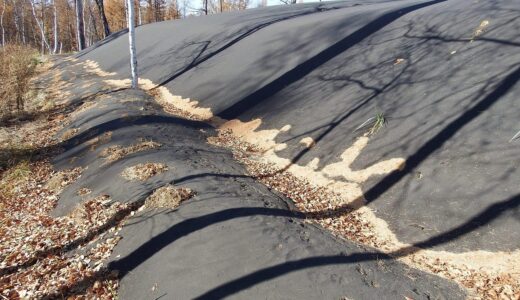
Under riprap, articulated concrete blocks or other armor layers, geotech fabric helps prevent soil loss caused by flowing water, wave action or runoff. The fabric must retain the protected soil and withstand installation damage from heavy stone placement. In severe hydraulic conditions, engineers may use granular filters, geotextiles or combined systems depending on flow, soil gradation, slope geometry and maintenance expectations. See also: Coatings.
Landfills and environmental containment
In landfill and containment systems, geotextiles are often used with geomembranes, drainage layers and geosynthetic clay liners. They may filter leachate collection aggregate, protect liner systems from puncture or form part of drainage composites. These are engineered systems with strict regulatory and project-specific requirements, so generic fabric descriptions are not enough for specification.
Railways, embankments and soft ground works
Geotech fabric can separate ballast from subgrade, provide filtration in drainage systems and support construction over weak soil. In soft ground applications, it may be part of a broader system that includes staged construction, prefabricated vertical drains, geogrids, geocells or improved fill. The fabric should be treated as one component in the ground improvement design, not as a standalone solution for every weak soil condition.
Selection factors that affect performance
Good geotech fabric selection starts with the design function and site conditions. The following factors are usually more useful than a simple comparison of roll weight or color:
- Soil gradation: Particle-size distribution helps determine filtration and retention requirements.
- Water conditions: Groundwater, surface runoff, hydrostatic pressure and flow direction affect permittivity and drainage needs.
- Construction survivability: Aggregate size, drop height, compaction equipment and traffic loads influence puncture, tear, grab strength and seam requirements.
- Opening size: Apparent opening size must be compatible with the soil to reduce particle migration without causing excessive clogging.
- Hydraulic capacity: Permeability, permittivity and transmissivity must be assessed according to whether water moves through or along the fabric.
- Durability: Resistance to ultraviolet exposure, chemical environment, biological effects and long-term stress should match project exposure.
- Installation details: Overlap, anchoring, seams, wrinkles, contamination and traffic before covering can determine whether the material performs as designed.
Standards provide a common baseline, but they do not remove the need for engineering judgment. AASHTO M 288, for example, is a material specification used in highway applications; it is not a complete design method for every site. Project engineers still need to evaluate soil, water, loading and construction conditions.
Common specification mistakes to avoid
One common mistake is treating all geotech fabric as interchangeable. A woven separator for a road base and a nonwoven drainage fabric behind a retaining wall may both be called geotextiles, but they are designed around different performance priorities. Using the wrong fabric can lead to clogging, soil loss, rutting or installation damage.
A second mistake is focusing only on tensile strength. Strength matters, especially for construction survivability and reinforcement-related uses, but filtration applications also require hydraulic compatibility. A strong fabric that clogs quickly may fail as a filter.
A third mistake is ignoring installation. Even correctly specified fabric can be damaged by sharp aggregate, excessive rutting, insufficient overlap, contamination with mud or prolonged ultraviolet exposure before covering. Field quality control should confirm that rolls are stored properly, subgrade is prepared, overlaps are maintained and aggregate is placed without tearing or displacing the fabric.
A fourth mistake is assuming geotech fabric can correct poor drainage design. Fabric can filter and help convey water, but it cannot overcome undersized outlets, blocked drains, poor grading or inadequate aggregate. Drainage systems need continuous flow paths from the water source to a safe discharge point.
How to read geotech fabric requirements in a project
When reviewing a project specification, start by identifying the intended function. If the function is separation, look for survivability class, tensile strength, puncture resistance and opening-size criteria. If the function is filtration, examine apparent opening size, permittivity and soil-retention requirements. If the function is drainage, check flow requirements and whether the design depends on cross-plane flow, in-plane flow or a drainage composite. If the function is protection, review puncture resistance, thickness and compatibility with adjacent materials.
Next, confirm the referenced standard and test methods. Common specifications may refer to ASTM terminology and test standards, AASHTO material classes, FHWA design guidance or state transportation requirements. The date or edition can matter because requirements may change over time. Finally, check installation notes, because field requirements are often as important as product values.
Frequently asked questions
Is geotech fabric the same as landscape fabric?
Not always. Some landscape fabrics are light-duty weed-control materials and are not designed for road, drainage or erosion-control loads. Geotech fabric used in civil engineering must meet project requirements for strength, opening size, water flow and durability.
Which is better, woven or nonwoven geotech fabric?
Neither is universally better. Woven fabric is often selected for separation and stabilization where strength and low elongation are important. Nonwoven fabric is often selected for filtration, drainage and protection because of its fiber structure and cushioning behavior. The better option depends on the primary function and site conditions.
Can geotech fabric stop water?
Standard geotech fabric is permeable, so it is not intended to stop water like a geomembrane. Its usual purpose is to let water pass while controlling soil movement. If a project needs a barrier function, a geomembrane or other geosynthetic barrier is normally evaluated.
Does heavier fabric always perform better?
No. Higher mass may improve cushioning or survivability in some cases, but performance depends on the required function. A heavy fabric can still be unsuitable if its opening size, permittivity or tensile behavior does not match the soil and water conditions.
Why does installation quality matter so much?
Geotech fabric works at the interface between soil, aggregate and water. Tears, wrinkles, clogged surfaces, poor overlaps or displaced fabric can create weak points where soil migration or water pressure develops. Proper placement and cover are essential for reliable performance.