Weaving types of fabric explained for practical textile selection

What weaving types of fabric mean
Weaving types of fabric describe how warp yarns and weft yarns interlace to form a woven textile. The three foundation structures are plain weave, twill weave and satin or sateen weave. Most other woven fabrics are variations, combinations or loom-controlled developments of these basic structures, including basket, rib, dobby, jacquard, leno, pile and double cloth.
For buyers, designers and sourcing teams, weave structure is a practical specification point because it can affect stability, drape, shine, texture, snag resistance, breathability and appearance. It does not work on its own. Fiber, yarn count, yarn twist, fabric density, finishing and dyeing also change performance. A useful fabric specification should therefore name the weave and define the yarn, construction, weight, width, finish and intended end use.
If you are comparing woven structures for apparel, home textiles or technical fabric development, the weaves category can be used as a starting point for related fabric structure topics.
How woven fabric structure works
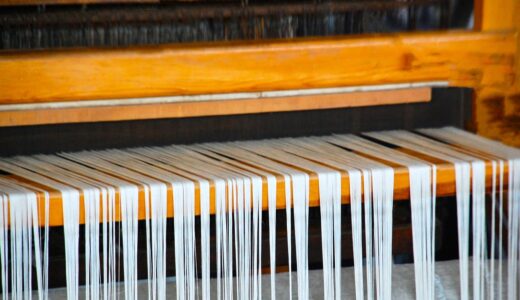
A woven fabric is built from two yarn systems. Warp yarns run lengthwise in the fabric, while weft yarns, also called filling yarns, run crosswise. During weaving, selected warp yarns are raised or lowered to create a shed, and the weft is inserted through that shed. The sequence in which warp and weft yarns pass over and under one another creates the weave.
Textile standards and technical references commonly describe weave as the pattern of interlacing between warp and weft. That definition is simple, but it matters in sourcing because many trade fabric names are not pure weave names. Denim is usually a twill, poplin is commonly a plain weave, and satin is both a structure term and a familiar fabric name. A term such as jacquard describes a method for controlling complex patterns, not one single interlacing pattern.
Three construction details are especially important when evaluating weaving types of fabric:
- Interlacing frequency: More frequent interlacing usually creates a firmer, more stable structure. Fewer interlacings create longer floats, which can improve smoothness and drape but may increase snag risk.
- Float length: A float is the portion of yarn that passes over several yarns before interlacing again. Long floats often improve luster and softness, but they need careful use in abrasion-prone applications.
- Repeat size: The repeat is the smallest unit of a weave that repeats across the fabric. Small repeats tend to look simple and regular; larger repeats allow more visible texture or pattern.
The three foundation weaves
Plain, twill and satin or sateen are widely treated as the three basic weave families. They are not the only woven constructions used in industry, but they provide the foundation for understanding most everyday woven fabrics.
Plain weave
Plain weave is the simplest interlacing structure. Each weft yarn normally passes over one warp yarn and under the next, then the sequence reverses in the following row. Because every yarn interlaces frequently, the structure is firm, balanced and relatively stable.
Common plain-weave fabrics include muslin, voile, organza, cambric, canvas, broadcloth and many shirting or lining fabrics. The same basic structure can feel very different depending on yarn size and density. A fine cotton voile may be light and sheer, while a heavy canvas can be stiff and durable. This is why weave type should not be read separately from yarn and weight.
The main advantages of plain weave are stability, simple production and low risk of long-float snagging. Its limits are also clear: it may have less drape than looser or longer-float structures, and it does not naturally create the diagonal texture, sheen or complex pattern that designers may require.
Twill weave
Twill weave is recognized by diagonal lines, often called wales. The diagonal effect is created when the interlacing point shifts by one or more yarns in each row. Common examples include 2/1 twill, 3/1 twill and 2/2 twill, where the numbers describe how yarns pass over and under each other in the repeat.
Denim, drill, gabardine, chino, serge and many workwear fabrics use twill structures or twill derivatives. Compared with a similar plain weave, twill often gives better drape and a more distinctive face. It can also visually hide soil and creasing because the diagonal surface breaks up light and shadow.
However, twill fabrics often have a clear face and back, and some constructions may be more prone to skew or torque if yarn, finishing and fabric relaxation are not controlled. When specifying twill, it is useful to state the twill direction, such as right-hand or left-hand twill, the repeat, the face side and the intended finishing route.
Satin and sateen weave
Satin-family weaves use longer floats arranged so that interlacing points are spread out rather than forming a strong diagonal line. This produces a smoother surface and can create higher luster because more yarn surface is exposed. The term satin is often associated with filament yarns and a glossy face, while sateen is frequently used for cotton or other spun-yarn fabrics with a satin-type structure. In trade, terminology can vary, so the technical construction should be specified.
Satin and sateen weaves are common in dress fabrics, linings, bedding, decorative textiles and some luxury apparel. Their appeal is smooth touch, fluid drape and surface shine. Their limitation is that longer floats can be more vulnerable to snagging, abrasion or pulled yarns than a compact plain weave. For this reason, satin structures need to be matched carefully to end use. A smooth lining and a high-contact workwear fabric do not face the same performance demands.
Extended weaving types of fabric beyond the basics
Many fabric categories are not separate from the three foundation weaves; they are modifications, combinations or special loom effects. Understanding this helps avoid a common sourcing mistake: treating market names as if they fully describe construction.
Basket and rib weaves
Basket weave is a plain-weave derivative in which two or more yarns act together, such as two warp yarns passing over two weft yarns. It can create a broader, more open texture than standard plain weave. Rib weave emphasizes raised lengthwise or crosswise ribs by using different yarn sizes, densities or grouping arrangements. Both can add surface interest, but looser versions may be less stable than a tight plain weave.
Dobby weave
Dobby fabric is made with a loom mechanism that controls small, repeated geometric patterns. Dots, checks, miniature diamonds and textured motifs are common. Dobby is best understood as a patterning capability rather than one single weave. The ground structure may be plain, twill, satin-based or a combination. For shirting, dress fabric and decorative textiles, dobby can add visual depth without the large-scale complexity of jacquard. See also: Applications.
Jacquard weave
Jacquard weaving allows individual or highly detailed control of warp yarns, enabling complex motifs, damasks, brocades, tapestries and decorative upholstery patterns. A jacquard fabric may include multiple weave structures in one design area. It is often associated with elaborate patterning, but the word jacquard does not automatically mean better quality. Fiber, yarn quality, density, finishing and pattern engineering still determine performance.
Leno weave
Leno weave locks weft yarns in place by twisting paired warp yarns around them. This can create open yet relatively stable constructions. It is used in gauze-like fabrics, mesh, curtains, some packaging textiles and technical or reinforcement applications. The key benefit is openness with controlled yarn movement. The main limitation is that production and design requirements are more specialized than for simple plain or twill fabrics.
Pile and double-cloth structures
Pile fabrics use additional yarns or special construction methods to form loops or cut pile on the surface. Terry towels, velvet, corduroy and some upholstery fabrics belong in this broad group. Double cloth uses two fabric layers woven together at selected points, allowing reversible effects, insulation, heavier body or engineered pockets. These structures are important when surface hand, absorption, warmth or dimensional effects are part of the design brief.
Comparison of common woven structures
| Weave type | Structure clue | Common examples | Typical advantages | Specification cautions |
|---|---|---|---|---|
| Plain weave | Over one, under one interlacing | Muslin, canvas, voile, poplin | Stable, simple, balanced, low float snagging | Can feel stiff or flat if density and yarn are not chosen well |
| Twill weave | Diagonal wale or rib | Denim, drill, gabardine, chino | Good drape, visible texture, strong fabric identity | Check twill direction, skew control and face side |
| Satin or sateen | Longer floats with smooth face | Satin, sateen, charmeuse, some linings | Smooth hand, luster, fluid drape | Long floats may snag or abrade in demanding use |
| Basket or rib | Grouped yarns or raised ribs | Oxford, hopsack, ribbed shirting | Texture, openness, casual appearance | Loose structures may distort without proper density |
| Dobby | Small repeated geometric effects | Dobby shirting, textured dress fabric | Subtle pattern without printing | Specify motif size, ground weave and face appearance |
| Jacquard | Complex woven motif | Damask, brocade, upholstery fabric | Large pattern range and rich surface design | Pattern complexity can affect cost, weight and floats |
| Leno | Twisted warp pairs locking weft | Gauze, mesh, open curtains | Open structure with improved yarn stability | Needs suitable yarn and loom setup for stable results |
How weave choice affects textile performance
Weave structure influences performance, but it is only one layer of fabric engineering. Two fabrics can share the same weave and still behave differently if one uses long-staple cotton and the other uses a short-staple yarn, or if one is tightly woven and the other is open and lightly finished.
Durability is often associated with tight constructions and frequent interlacing, which is why plain weave can be very stable. Yet a heavy twill denim may outperform a lightweight plain weave in abrasion simply because yarn size, density and weight are very different. The correct comparison must hold other variables as constant as possible.
Drape and softness often improve when floats are longer or the construction is less rigid. Satin, sateen and some twills may feel smoother and more fluid than a comparable plain weave. This is useful for linings, dresses and bedding, but it may not be the best choice where surface abrasion is severe.
Breathability and openness depend on cover factor, yarn size and finishing as much as weave. A loose plain weave can be airy; a dense plain weave can be wind resistant. Leno and mesh structures are chosen when openness must be maintained with better yarn control.
Appearance is one of the most visible differences. Plain weave looks balanced and regular, twill shows diagonal movement, satin emphasizes shine, dobby adds small texture, and jacquard creates woven pattern. For product development, this means the weave should be selected early, not treated as a minor production detail after color and fiber are chosen.
How to specify the right weave for sourcing
A clear woven fabric specification reduces misunderstanding between design, merchandising, mill and quality teams. Instead of asking only for a fabric name, define the construction features that can be checked and reproduced.
- Name the weave structure: Use terms such as 1/1 plain weave, 2/1 twill, 3/1 twill, five-end satin, dobby or jacquard where appropriate.
- State fiber content and yarn details: Include fiber blend, yarn count, filament or spun yarn, twist direction if relevant, and any special yarn effect.
- Define density and weight: Ends per inch or centimeter, picks per inch or centimeter, GSM and finished width help determine hand, opacity and stability.
- Identify the face side: This is important for twill, satin, sateen, jacquard and pile fabrics where face and back may differ clearly.
- Set performance requirements: Depending on end use, consider abrasion resistance, tear strength, pilling, dimensional change, colorfastness, air permeability and laundering or dry-cleaning behavior.
- Describe finishing: Brushing, calendering, mercerizing, coating, washing, sanforizing and softening can change the final fabric as much as the weave itself.
For practical selection, start with end use. Shirts often need comfort, appearance and laundering stability. Workwear may prioritize abrasion and tear strength. Bedding may emphasize hand, smoothness and dimensional stability. Curtains may require drape, light control and decorative effect. No weave type is universally best; each is a trade-off between structure, yarn, finish, cost and performance requirements.
Frequently asked questions
Are fabric type and weave type the same?
No. A fabric type may describe fiber, construction, finish, appearance or market category. A weave type specifically describes how warp and weft interlace. For example, denim is a fabric category that is commonly woven as twill, while satin is both a weave structure and a fabric name in common trade language.
Which weaving type of fabric is the strongest?
There is no single strongest weave in every situation. Plain weave is structurally stable because of frequent interlacing, but a heavier twill may be stronger than a lightweight plain weave. Strength depends on fiber, yarn quality, fabric density, finishing and test method as well as weave.
Is satin always made from silk?
No. Satin refers to a weave structure with a smooth, float-dominant face. It can be made from silk, polyester, acetate, nylon or other filament yarns. Sateen is often used for cotton or spun-yarn fabrics with a satin-type structure.
How can I identify plain, twill and satin visually?
Plain weave usually looks like a simple over-under grid. Twill shows diagonal ribs or wales. Satin or sateen usually has a smoother, shinier face with fewer visible interlacing points. A magnifier helps because finishing and yarn type can make structures harder to see with the naked eye.
Why do two fabrics with the same weave feel different?
Weave is only one part of fabric construction. Fiber type, yarn count, twist, density, weight, chemical finishing and mechanical finishing all affect touch, drape, opacity and durability. This is why a fabric brief should include complete construction details rather than relying on weave name alone.